 24 X 7 online support
  Contact Us Free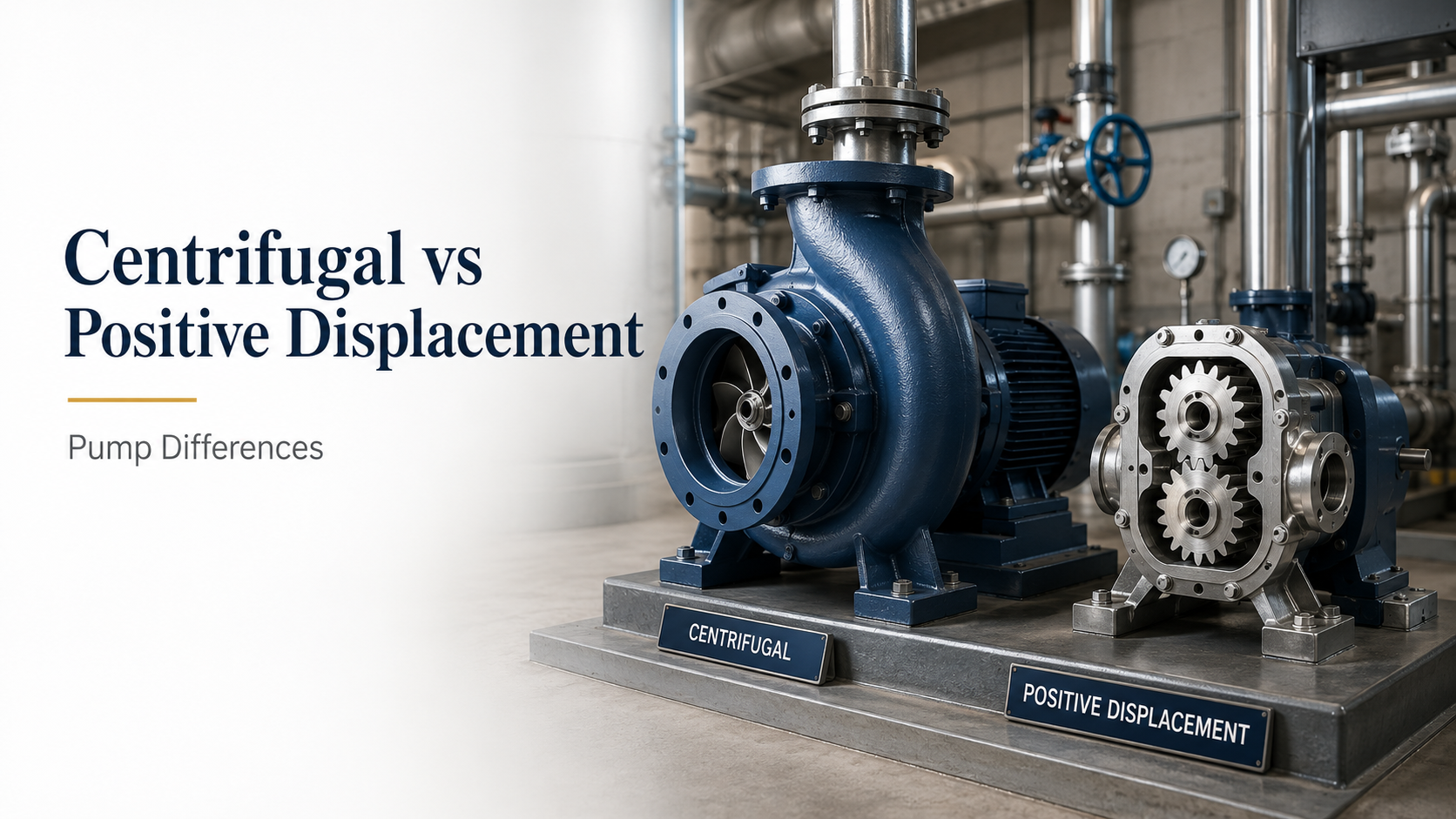
What Is the Difference Between a Centrifugal and Positive Displacement Pump?
The main difference between centrifugal and positive displacement pumps lies in their pumping principles: A centrifugal pump uses an impeller to convert kinetic energy into dynamic pressure through rotational motion, producing continuous flow that varies with system pressure. In contrast, a positive displacement pump traps fluid in an expanding cavity and forces it through a contracting cavity, delivering constant volume regardless of discharge pressure. According to API standards (2024), centrifugal pumps dominate low-viscosity, high-flow applications, whereas positive displacement pumps excel at high-viscosity fluids and metering applications requiring volumetric efficiency above 95%.
How Do Centrifugal Pumps Differ From Positive Displacement Pumps in Operating Principle?

The fundamental distinction between these pump types compared involves their fluid transfer mechanisms and pump working principle. A centrifugal pump operates as a dynamic pump that accelerates fluid through a rotating impeller housed within a volute casing. The impeller increases fluid velocity, which Bernoulli’s principle then converts into pressure at the discharge line. This kinetic energy transformation means flow rate decreases as head pressure increases, creating a characteristic pump curve.
Positive displacement pumps function through mechanical displacement rather than centrifugal force. These displacement pumps—including piston pumps, diaphragm pumps, gear pumps, screw pumps, peristaltic pumps, lobe pumps, vane pumps, and progressive cavity pumps—create flow by trapping fixed volumes of fluid and forcing them from suction line to outlet pressure. The pumping action occurs through reciprocating motion in reciprocating pumps or rotary motion in rotary pumps. Unlike centrifugal technology, positive displacement delivers pressure-independent flow with minimal slip.
The pump mechanics fundamentally differ: centrifugal pump operation requires fluid to prime the suction characteristics, while many positive displacement designs offer self-priming capability. The rotodynamic pumps category encompasses centrifugal designs, whereas kinetic pumps represent a broader classification of dynamic pumps. According to ISO standards (2023), these pump classification differences determine proper pump selection criteria across industrial pump systems.
Comparison Table: Centrifugal Pump Versus Positive Displacement Pump Applications

| Feature | Centrifugal Pump | Positive Displacement Pump |
|---|---|---|
| Operating Principle | Converts kinetic energy to dynamic pressure via rotating impeller | Traps and displaces fixed volumes through expanding/contracting cavities |
| Flow Characteristics | Variable flow rate; decreases with pressure rise | Constant flow rate; proportional to speed regardless of pressure |
| Pressure Generation | Maximum ~200 psi typical; pressure dependent on fluid velocity | Can exceed 5000 psi; pressure limited by mechanical strength |
| Viscosity Performance | Efficiency drops 30-45% above 200 cP; optimal for low viscosity fluids | Maintains efficiency with high viscosity fluids up to 1,000,000 cP |
| Flow Pattern | Continuous flow with smooth discharge characteristics | Pulsating flow in reciprocating types; continuous in rotary designs |
| Efficiency Range | Peak hydraulic efficiency 70-85% at best efficiency point | Volumetric efficiency 85-98% across operating pressure range |
| Self-Priming | Typically requires priming; no self-priming capability in standard designs | Most types offer self-priming; capable of suction lift 6-25 feet |
| Speed Variation | Flow proportional to speed; easy throttling control via rpm variation | Fixed displacement per revolution; speed changes alter volumetric flow directly |
| Maintenance | Simple construction; fewer wearing parts; lower maintenance requirements | More complex with mechanical seals, bearings; higher pump maintenance needs |
| Cost | Lower initial cost; economical for large flow applications | Higher initial investment; justified for precision or high-pressure needs |
What Are the Flow Rate Characteristics of Centrifugal Versus Positive Displacement?
Flow versus pressure relationships fundamentally distinguish these pump technologies. A centrifugal pump exhibits inverse correlation between discharge pressure and flow rate, documented in its performance curve. At zero flow (dead-head condition), pressure reaches maximum; as flow increases, head pressure decreases along the pump curve. According to ANSI standards (2024), the best efficiency point (BEP) typically occurs at 60-80% of maximum flow where the operating point intersects optimal system curves.
The affinity laws govern centrifugal pump characteristics: flow changes linearly with rotational speed, head varies with speed squared, and brake horsepower changes with speed cubed. This relationship enables simple flow control methods through speed variation using variable frequency drives or throttling control via discharge valve adjustment. The pump capacity remains flexible across the duty point range, making these kinetic pumps ideal for variable flow applications.
Positive displacement pumps deliver constant volume per revolution regardless of differential pressure. The volumetric flow equals displacement multiplied by rpm with minimal slip—typically less than 2% in well-designed systems. This pressure versus flow independence means pump discharge remains stable even as outlet pressure fluctuates from 50 to 5000 psi. The pump functionality provides metering accuracy within ±1% for dosing applications requiring precise chemical pumping or oil pumping volumes.
However, positive displacement designs produce pulsation—cyclic pressure variations at the pump outlet. Reciprocating pumps exhibit more pronounced pulsating flow than rotary pumps, requiring pulsation dampeners in sensitive applications. The trapped volume mechanism creates pressure spikes during each cycle, whereas centrifugal designs maintain smooth continuous flow throughout pump operation.
When to Use Centrifugal vs Positive Displacement Pump for Viscosity Applications?
Viscosity dramatically affects pump performance and pump selection criteria. Centrifugal pumps perform optimally with low viscosity fluids below 100 cP—including water pumping, thin chemicals, and light petroleum products. As fluid viscosity increases, the impeller’s ability to impart kinetic energy diminishes. Testing by pump engineering researchers (2023) demonstrates that centrifugal pump efficiency factors drop from 78% at 1 cP to 45% at 500 cP, with corresponding reductions in pump head and capacity.
The viscosity effect on centrifugal vs positive displacement pumps becomes critical above 200 cP. Centrifugal technology struggles with high viscosity fluids due to increased internal recirculation, higher friction losses, and reduced fluid dynamics within the volute casing. The rotating impeller cannot effectively accelerate thick fluids, resulting in poor suction characteristics and potential cavitation issues when NPSH requirements aren’t met.
Positive displacement pumps excel at high viscosity pumping centrifugal vs positive displacement comparisons. Gear pumps, screw pumps, and progressive cavity pumps maintain volumetric efficiency above 90% with fluids exceeding 50,000 cP. The positive displacement working principle creates pumping action through mechanical force rather than fluid acceleration, making viscosity largely irrelevant to flow generation. Heavy oils, polymers, adhesives, and food products requiring gentle pumping benefit from this displacement-based approach.
For shear sensitive fluids, however, pump selection requires careful analysis. Centrifugal designs produce lower shear rates (typically 1000-5000 s⁻¹) compared to gear pumps (up to 20,000 s⁻¹). Peristaltic pumps and lobe pumps offer gentle pumping action suitable for biological materials, whereas aggressive pumping in high-speed centrifugal or gear configurations may damage delicate emulsions or cell suspensions.
Which Is Better Centrifugal or Positive Displacement Pump for Efficiency and Power?
Hydraulic efficiency and brake horsepower requirements differ substantially between these pump classifications. Centrifugal pumps achieve peak hydraulic efficiency of 70-85% at their best efficiency point, but efficiency drops significantly when operating away from design conditions. The efficiency curve shows steep decline at partial flows or higher-than-design pressures. According to industrial pump systems data (2024), centrifugal units operating 20% below BEP lose approximately 15% efficiency.
Hydraulic horsepower (HHP) for centrifugal designs depends on flow rate, head pressure, and specific gravity: HHP = (Flow × Head × SG) / 3960. The prime mover—typically an electric motor—must supply brake horsepower (BHP) equal to HHP divided by efficiency. Variable speed operation using modern motor controls optimizes pump efficiency factors across varying demand, reducing energy consumption 20-40% compared to throttling control methods.
Positive displacement pumps maintain volumetric efficiency between 85-98% across their operating pressure range, exhibiting flatter efficiency curves than centrifugal alternatives. The mechanical efficiency depends on internal clearances, seal friction, and bearing losses rather than fluid dynamics. Slip—internal leakage from discharge to suction—represents the primary efficiency loss, typically under 2% in well-maintained units but increasing with wear or low-viscosity fluids.
Energy efficiency centrifugal versus positive displacement pumps favors centrifugal designs for high-flow, low-pressure applications due to simpler construction and continuous flow. Conversely, metering applications and high-pressure duties benefit from positive displacement’s consistent volumetric delivery. The operating point selection dramatically impacts overall system efficiency: properly matched centrifugal pumps operating near BEP often consume 30% less energy than positive displacement alternatives in water transfer systems.
Advantages of Centrifugal Pumps Over Positive Displacement Pumps
Centrifugal technology offers distinct advantages for many industrial applications. The simple construction features fewer moving parts—primarily the impeller, shaft, mechanical seal, and bearings—resulting in lower maintenance requirements centrifugal vs positive displacement pumps. This pump design translates to higher pump reliability and reduced downtime in continuous-operation facilities performing chemical pumping or water supply duties.
Cost comparison centrifugal vs positive displacement pumps strongly favors centrifugal for large-flow applications. Initial pump installation expenses run 40-60% lower for equivalent flow capacity, with additional savings in pump operation due to simpler controls. The compact footprint and lighter weight reduce foundation requirements and installation complexity. According to pump technology industry analysis (2024), total cost of ownership over 10 years averages 35% less for centrifugal systems in high-flow, low-viscosity applications.
Flow control flexibility represents another centrifugal advantage. Throttling control via discharge valve adjustment provides infinite variability without damaging the pump, whereas restricting positive displacement discharge creates dangerous pressure buildup. Variable speed operation through VFD control enables precise flow adjustment from 20-100% capacity while reducing energy consumption. The pump characteristics permit parallel operation of multiple units for redundancy and capacity modulation.
Smooth continuous flow eliminates pulsation issues, protecting downstream equipment and process stability. The absence of trapped volume mechanisms means centrifugal pumps handle entrained gases and solids handling applications better than many displacement designs. Slurry pumping in mining and wastewater treatment relies heavily on robust centrifugal construction capable of passing spherical solids up to 80% of discharge diameter.
Advantages of Positive Displacement Pumps Over Centrifugal Pumps
Positive displacement technology excels where metering accuracy centrifugal vs positive displacement pumps becomes critical. The constant volume delivery provides dosing precision within ±1%, essential for chemical injection, fuel metering, and pharmaceutical manufacturing. Flow remains proportional to pump speed regardless of system pressure changes, enabling reliable metering applications without complex control systems.
Self-priming capability constitutes a major operational advantage. Most positive displacement designs—particularly diaphragm pumps, peristaltic pumps, and vane pumps—achieve suction lift of 6-25 feet without external priming systems. This self priming capability centrifugal vs positive displacement distinction eliminates auxiliary equipment and simplifies pump installation in applications with intermittent flow or suction conditions above the fluid source.
High-pressure generation capability dramatically exceeds centrifugal limits. Piston pumps routinely generate pressures exceeding 5000 psi, while specialized plunger designs reach 30,000 psi for hydraulic applications. This operating pressure range centrifugal vs positive displacement differential makes positive displacement the only viable choice for high-pressure injection, hydraulic power units, and pressure testing systems.
Viscosity independence represents perhaps the most significant advantage. Unlike centrifugal designs that suffer 40-60% efficiency loss above 500 cP, positive displacement pumps maintain performance with fluids up to 1,000,000 cP. The pump mechanics rely on mechanical displacement rather than fluid acceleration, making them ideal for polymer transfer, asphalt pumping, and food processing applications involving viscous products.
Use-Case Scenarios: When to Select Positive Displacement Pump Instead of Centrifugal
Scenario 1: Chemical Metering and Dosing Applications
A water treatment facility requires precise polymer injection at 5 gallons per hour with ±0.5% accuracy despite varying system pressure from 50-150 psi. A diaphragm pump or peristaltic pump delivers constant volumetric flow independent of pressure fluctuations, ensuring accurate dosing. Centrifugal alternatives would require complex flow monitoring and feedback control, adding cost and complexity. The positive displacement approach provides reliable metering accuracy with simple speed adjustment via VFD control.
Scenario 2: High-Viscosity Oil Transfer
An oil refinery needs to transfer 50 GPM of heavy fuel oil (viscosity 2000 cP) at 100°F from storage to process units. A twin-screw pump or gear pump maintains 95% volumetric efficiency across the viscosity range, whereas a centrifugal pump would require oversizing by 200-300% and consume excessive power while delivering unreliable flow. The positive displacement design handles temperature variations without performance degradation, providing pump reliability critical for continuous operation.
Scenario 3: High-Flow Water Supply System
A municipal water system pumps 5000 GPM at 150 feet of head from reservoir to distribution. A large centrifugal pump delivers required capacity at 80% efficiency with simple construction, low maintenance, and excellent pump durability. The continuous flow suits the steady-state application, while variable speed operation optimizes energy efficiency during demand fluctuations. Positive displacement alternatives would cost 2-3 times more initially and require significantly more maintenance for equivalent duty.
Scenario 4: Shear-Sensitive Biotechnology Application
A pharmaceutical manufacturer processes cell cultures requiring gentle fluid transfer at 10 GPM with minimal shear stress below 1000 s⁻¹. A peristaltic pump or lobe pump provides gentle pumping action while maintaining sterility through complete fluid containment. The low shear rate protects delicate biological materials, whereas centrifugal impellers would damage cells through excessive turbulence. The self-priming capability simplifies installation for batch processing with frequent starts and stops.
Pump Selection Guide: Decision Framework for Centrifugal or Positive Displacement
Choose a centrifugal pump when:
- Fluid viscosity remains below 200 cP (water, light chemicals, solvents)
- Flow rate exceeds 100 GPM with moderate pressure requirements (under 200 psi)
- Application requires continuous flow without pulsation
- Variable flow applications benefit from throttling or speed control
- Lower initial cost and maintenance requirements drive selection
- Handling entrained air or solids handling capabilities are needed
- Space and weight constraints favor compact design
- Energy efficiency at high flows justifies selection
Choose a positive displacement pump when:
- High viscosity fluids exceed 200 cP (oils, polymers, food products)
- Metering accuracy within ±1% is required regardless of pressure
- System pressure exceeds 300 psi or requires high-pressure generation
- Self-priming capability eliminates need for external priming systems
- Constant flow rate must be maintained despite pressure variations
- Shear-sensitive fluids require gentle pumping action
- Suction lift conditions exist without flooded suction
- Flow rates under 100 GPM with precise volumetric control
Hybrid applications may benefit from combining both pump types. For example, using centrifugal pumps for bulk transfer with positive displacement pumps for final metering optimizes both cost and performance. Consulting pump types compared resources and following API standards, ISO standards, and ANSI standards ensures proper system design meeting specific application requirements.
Summary: Main Difference Between Centrifugal and PD Pumps
The fundamental differences in construction centrifugal and positive displacement pumps stem from their pumping principles: centrifugal technology converts rotational kinetic energy into pressure through an impeller mechanism, creating variable flow dependent on system resistance, while positive displacement captures and mechanically forces fixed volumes, delivering constant flow independent of pressure. According to pump engineering standards (2024), centrifugal designs dominate applications requiring high flow rates above 100 GPM with low-viscosity fluids under 200 cP, offering 30-40% lower total ownership costs. Conversely, positive displacement excels at metering applications, high-pressure duties above 300 psi, and high-viscosity fluids where volumetric efficiency and flow consistency outweigh initial cost considerations. Proper pump selection criteria must evaluate fluid properties, flow characteristics, pressure requirements, and operational constraints to determine optimal pump technology for specific industrial pumping systems.